Moonlight
The Moon is one of the brightest objects in the night sky. Although it does not create light pollution, its reflected sunlight brightens the sky background, reducing the contrast of faint deep-sky objects such...
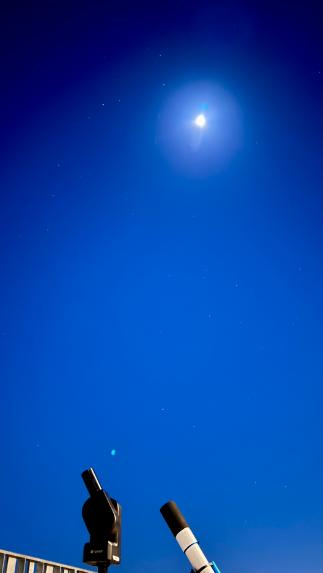
The Moon is one of the brightest objects in the night sky. Although it does not create light pollution, its reflected sunlight brightens the sky background, reducing the contrast of faint deep-sky objects such as nebulae and galaxies. The brighter the Moon, the more difficult it becomes to capture weak details.
The Moon’s effect depends on its phase, altitude, and angular distance from your target. A full Moon high in the sky can brighten almost the entire sky, while a thin crescent Moon near the horizon has much less impact.
Best Ways to Avoid Moonlight The simplest solution is to image during the New Moon, when the Moon is absent from the night sky. This provides the darkest skies and the highest contrast for faint deep-sky objects.
If imaging during moonlit nights is unavoidable:
- Prefer a target farther from the Moon, but treat separation as a gradient rather than a magic cutoff.
- Choose a target high enough to reduce atmospheric scattering and avoid local haze.
- Wait for the Moon to set, or begin before it rises.
- Use an appropriate narrowband filter for an emission nebula; the filter will not make moonlight or gradients disappear.
- Save faint broadband targets such as galaxies and reflection nebulae for darker windows when practical.
The useful decision combines Moon phase, altitude, separation, transparency, target spectrum, and filter passband. A low target close to a bright Moon may produce fewer usable frames even when the session runs for the same clock time.