Learning area
Tools and Equipment
A grounded look at what equipment can do, what it cannot do, and why fit matters more than prestige.
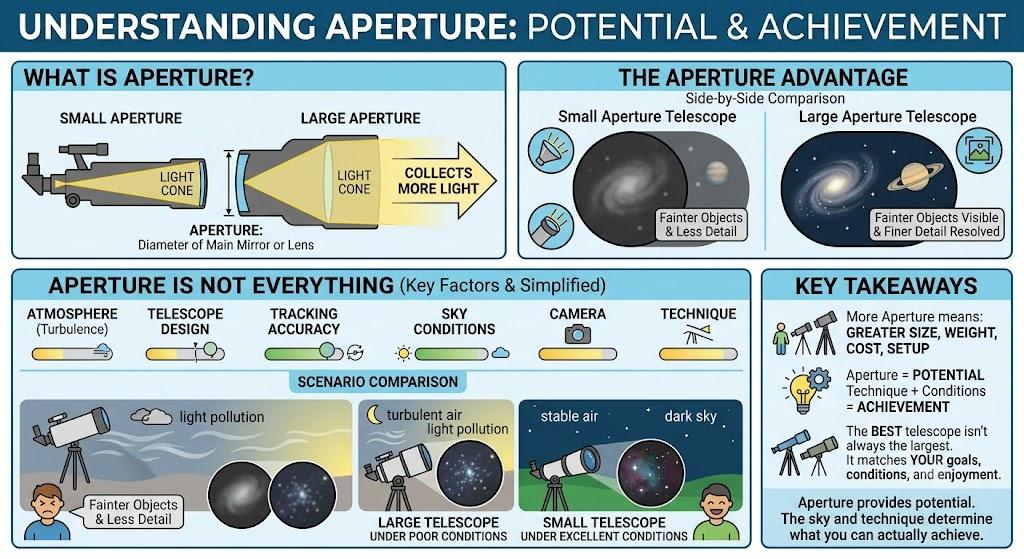
Aperture
Aperture is the diameter of a telescope's main optical element, such as the lens or mirror. It determines how much light the telescope can collect and how much detail it can potentially reveal.
Tools and EquipmentFocal Length
Focal length is the distance between a telescope's optical system and the point where light is brought into focus. In simple terms, it determines how large an object appears and how much of the...
Tools and EquipmentFocal Ratio
Focal ratio describes the relationship between a telescope’s aperture and focal length. It is commonly written as f/number, such as f/4, f/6.7, or f/10.
Tools and EquipmentMounts
A telescope mount is the system that supports and moves the telescope. It is one of the most important parts of an astronomy setup because it determines how easily and accurately you can observe...
Tools and EquipmentYour Eyes
Your eyes are your first astronomical instrument. Long before telescopes existed, humans studied the universe simply by looking at the night sky.
Tools and EquipmentCameras
A camera is a tool that allows us to capture and record the light from the universe.
Tools and EquipmentFilters
Filters are tools used in astronomy to control which wavelengths of light reach your eyes or camera.