Target Altitude
Target altitude refers to how high an object appears above the horizon when we observe it in the sky.
Target altitude refers to how high an object appears above the horizon when we observe it in the sky.
When a celestial object is higher in the sky, its light passes through less atmosphere, producing sharper images, better contrast, and improved astrophotography.
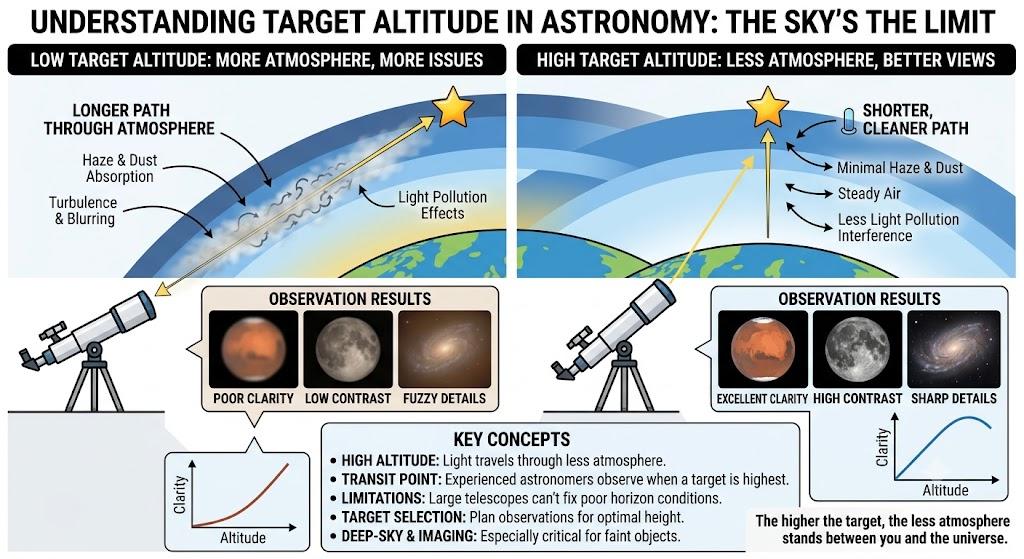
Experienced astronomers therefore plan around the period when a target is high enough to provide useful data. A range such as 40°–70° can be a helpful example, but it is not a universal optimum. Some targets never reach it from a given latitude, and mount accuracy does not automatically improve merely because the target enters that band.
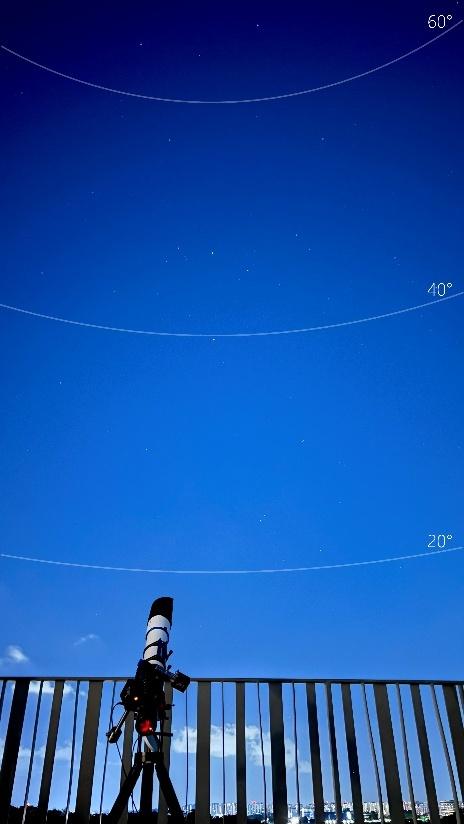 Figure 2
For multi-night projects, capture at similar altitudes and times to ensure more consistent data for easier stacking. Even the largest telescope cannot overcome the image degradation caused by observing too close to the horizon.
Airmass and the useful window
Airmass describes the relative path length through the atmosphere. It is approximately 1 overhead and increases toward the horizon. More atmosphere usually means more extinction, scattering, color change, and sensitivity to haze or skyglow.
The best window is usually near culmination, but the real decision also includes obstructions, Moon position, local light domes, wind, and mount limits. A low target can still be worth imaging; it simply needs realistic expectations and often stricter frame review.