Seeing
Seeing describes the stability of the atmosphere and how much it affects the sharpness of what we observe.
Seeing describes the stability of the atmosphere and how much it affects the sharpness of what we observe.
When light from stars and planets travels through Earth’s atmosphere, it passes through layers of moving air. These movements can bend and distort the light, causing stars to twinkle and making planets appear blurry.
Good seeing means the atmosphere is calm and stable. Fine details, especially on the Moon and planets, become sharper and easier to observe.
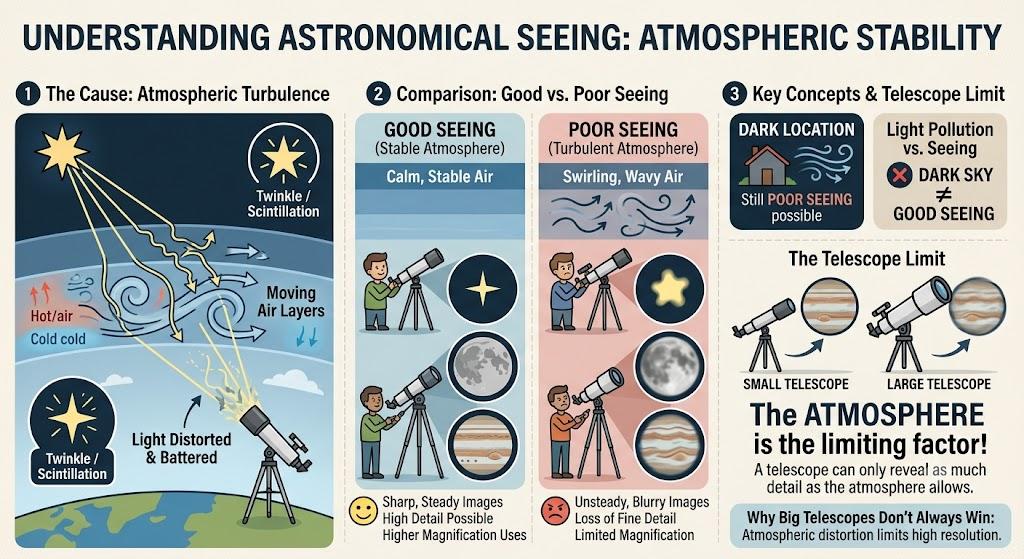
Poor seeing causes images to appear unsteady, reducing the amount of detail that telescopes and cameras can capture. This is especially noticeable when using longer focal lengths or high magnification.
Unlike light pollution, seeing is not improved simply by travelling to a darker location. A dark sky can still have poor seeing if the atmosphere is turbulent.
Understanding seeing helps explain why a larger telescope or higher magnification does not always produce better results. The atmosphere can become the limiting factor.
Seeing matters more as focal length increases and image scale becomes finer: the system tries to record smaller detail that atmospheric motion is smearing. Deep-sky photographers may respond by choosing a wider-field target or accepting softer stars. Planetary imagers use a different strategy—very short exposures at high frame rate, then select and combine the sharpest moments in a process called lucky imaging.