Aperture
Aperture is the diameter of a telescope's main optical element, such as the lens or mirror. It determines how much light the telescope can collect and how much detail it can potentially reveal.
Aperture is the diameter of a telescope’s main optical element, such as the lens or mirror. It determines how much light the telescope can collect and how much detail it can potentially reveal.
A larger aperture collects more light, allowing you to observe fainter objects and resolve finer details. This is especially useful when viewing planets, distant galaxies, and faint nebulae.
However, aperture is not the only factor that determines the quality of an observation or image. The atmosphere, telescope design, tracking accuracy, camera, sky conditions, and observing techniques all play important roles.
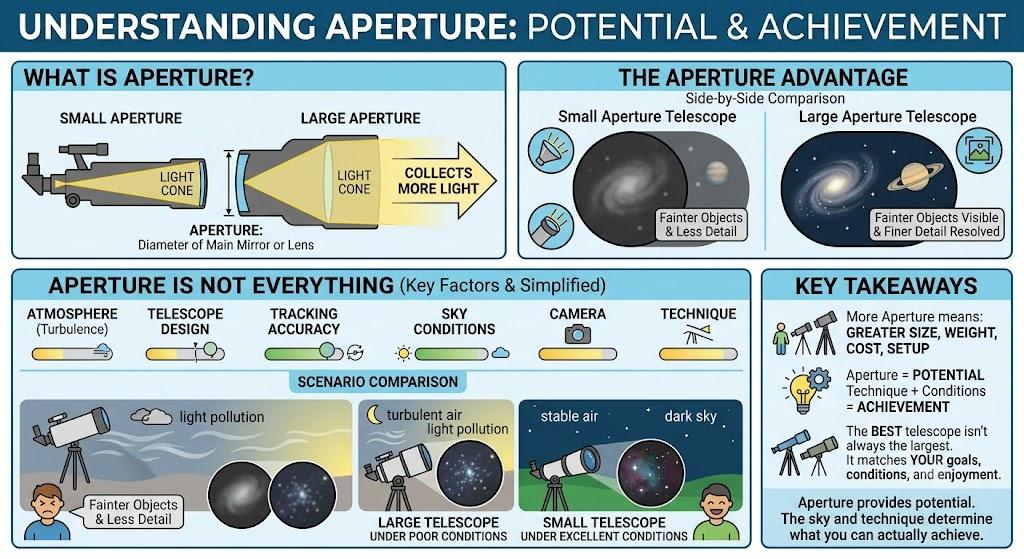
A larger telescope under poor sky conditions may perform worse than a smaller telescope under excellent conditions. More aperture also often means greater size, weight, cost, and setup requirements.
The best telescope is not always the largest one. It is the one that matches your goals, your observing conditions, and how you want to enjoy astronomy.
For imaging, aperture must be judged as part of a system. Target framing comes from focal length and sensor size; recorded detail depends on sampling and seeing; usable exposure depends on the mount. A larger instrument can collect more light yet be a worse choice for a large subject if its field is too narrow or the complete setup is too difficult to use consistently.
Aperture provides potential. The sky and technique determine what you can actually achieve.