Understanding Light
Light is the foundation of astronomy. Almost everything we know about the universe comes from studying the light that reaches Earth.
Light is the foundation of astronomy. Almost everything we know about the universe comes from studying the light that reaches Earth.
Light carries valuable information. It tells us how bright an object is, how far away it may be, how hot it is, what it is made of, and even whether it is moving towards or away from us.
Our eyes can only see a small part of the light that exists. Many celestial objects also emit infrared, ultraviolet, radio waves, X-rays, and other forms of light that are invisible to us.
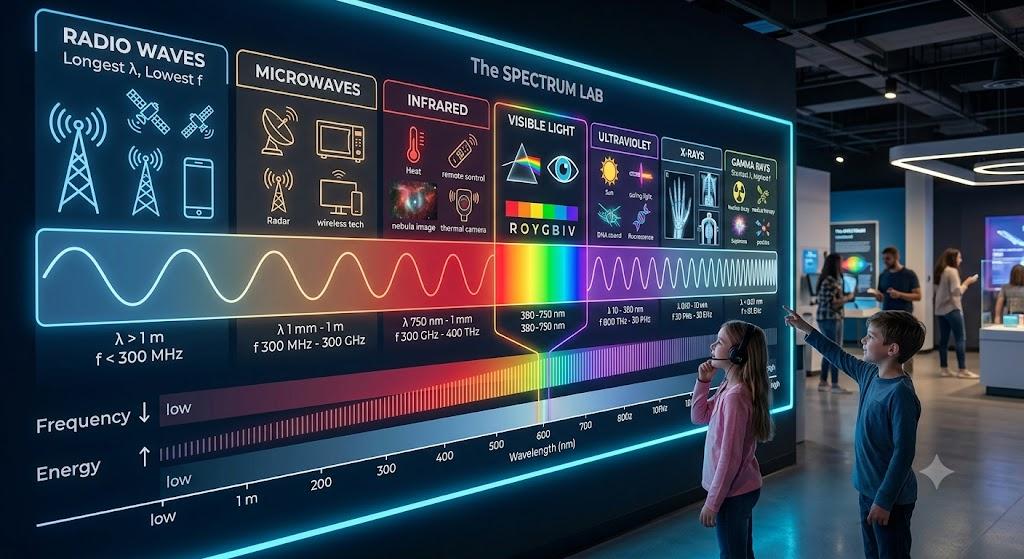
Modern cameras and scientific instruments can detect some of these invisible wavelengths, revealing details our eyes cannot see.
Continuum and emission-line light
A spectrum describes how light is distributed across wavelength. Stars, galaxies, and reflection nebulae contain broad or continuum light. Excited gas in an emission nebula can also glow strongly at particular wavelengths, including hydrogen-alpha, oxygen III, and sulfur II.
This difference determines what a filter can accomplish. A narrowband filter passes selected emission lines and blocks much of the rest of the spectrum across the whole frame. It can increase an emission nebula’s contrast while weakening stars, galaxies, and reflected dust. The filter separates existing light; it does not add signal.
Continue with Filters or Narrowband Imaging.
A telescope does not create light or magnify the universe into existence. Its main job is to collect more light. The more useful light we collect, the more information we can observe and record.