Mounts
A telescope mount is the system that supports and moves the telescope. It is one of the most important parts of an astronomy setup because it determines how easily and accurately you can observe...
A telescope mount is the system that supports and moves the telescope. It is one of the most important parts of an astronomy setup because it determines how easily and accurately you can observe or capture images.
A good telescope on a poor mount will struggle, while a smaller telescope on a stable mount can often perform much better.
Alt-Azimuth mounts
An Alt-Az mount moves the telescope in altitude and azimuth. It is simple to use and well suited to visual observation and many automated smart telescopes.
Equatorial mounts
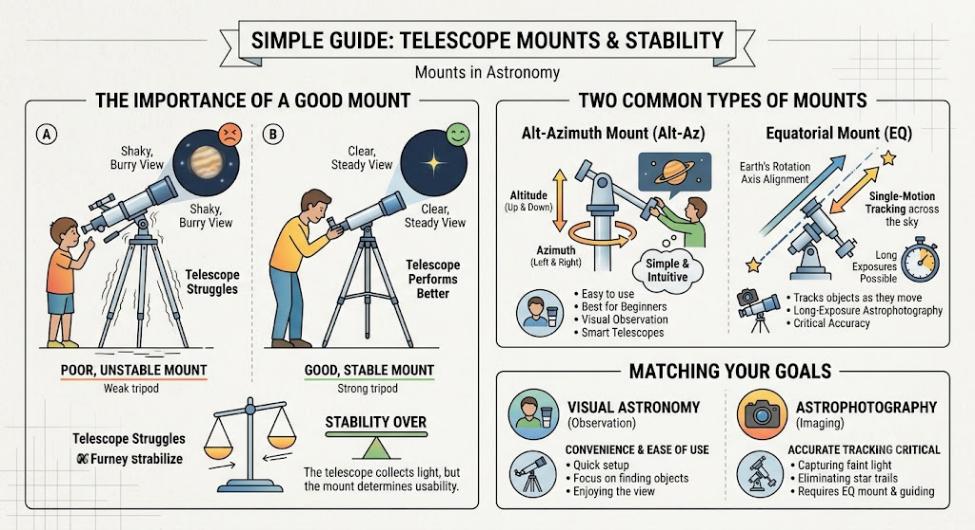
An equatorial mount has a right-ascension axis aligned with Earth’s rotation axis. Once polar-aligned, it can follow the apparent motion of the sky without rotating the camera field in the same way as an Alt-Az mount. This makes it especially useful for long-exposure astrophotography.
An Alt-Az mount can still produce sharp individual subframes, but the field rotates as the target moves. Stacking software can align the shared center of those frames; the outer edges receive less overlapping data and therefore become noisier or require cropping.
Shorter subs reduce rotation within each exposure, but they do not remove the change between exposures. The clean common field shrinks over a long session. This matters especially for mosaics, where lost edges reduce panel overlap.
When EQ becomes worthwhile
Consider equatorial operation when field rotation is consuming too much of the frame, the project requires longer subs behind a strong filter, a mosaic needs stable orientation, or repeated cropping is limiting the desired composition.
EQ introduces its own work: polar alignment, balancing, cable management, and sometimes a meridian flip. A meridian flip changes the telescope’s orientation when crossing the mount’s limit; the frames can still be registered, but framing and cable clearance need attention.
For a first EQ session, choose an unobstructed part of the sky that your equipment can track comfortably, and reserve time to learn the adjustment controls before the imaging window begins. Avoid treating one altitude band or one alignment number as universal. The current Seestar procedure, for example, asks the user to level the tripod, set the approximate latitude and north/south direction, then refine the azimuth and elevation errors to less than 1° without moving the device afterward.1
Stability is a complete system
A precise polar alignment cannot rescue a platform that shifts during capture. Every center column, leveler, adapter, quick-release plate, and unlocked joint adds another place where the system can flex or settle.
When configuring a tripod:
- keep the center column low when practical;
- prefer thicker leg sections before extending the thinnest sections;
- place the load over a leg rather than between unsupported legs when the manufacturer recommends it;
- add ballast only where it cannot swing or create a tipping hazard;
- isolate footsteps and deck vibration; and
- confirm that the telescope, mount arm, knobs, and cables clear the tripod through their full range of motion.
A leveler or wedge can still be valuable even when it is not optically required. Extra clearance may prevent a collision, and fine, repeatable controls can make polar alignment much easier than loosening a coarse joint under load. The tradeoff is another mechanical connection. Judge the adapter by repeatability, locked stability, clearance, and ease of adjustment—not by price or the number of controls alone.
For visual astronomy, convenience and ease of use are often the most important factors.
For astrophotography, accurate tracking becomes critical because cameras collect light over long periods.
A larger telescope does not automatically produce better results if the mount cannot support it properly. Stability, tracking accuracy, and ease of operation are often more important than size alone.
The telescope collects the light, but the mount determines how well you can use it.
Notes and external sources
Footnotes
-
ZWO Seestar, How to switch to EQ mode on the Seestar app. The current official procedure distinguishes the initial level/latitude setup from image-based azimuth and elevation correction, defines completion as both deviations below 1°, and warns against moving the device afterward. ↩