
Focal Ratio
Focal ratio describes the relationship between a telescope’s aperture and focal length. It is commonly written as f/number, such as f/4, f/6.7, or f/10.
Focal ratio describes the relationship between a telescope’s aperture and focal length. It is commonly written as f/number, such as f/4, f/6.7, or f/10.
In simple terms, focal ratio affects how quickly a telescope collects light and how the image appears.
A lower focal ratio, such as f/4, is considered a faster telescope. It collects light more quickly and is often useful for capturing large, faint deep-sky objects in a shorter amount of time.
A higher focal ratio, such as f/10, is considered a slower telescope. It usually requires longer exposure times but can provide a larger image scale when combined with a suitable focal length.
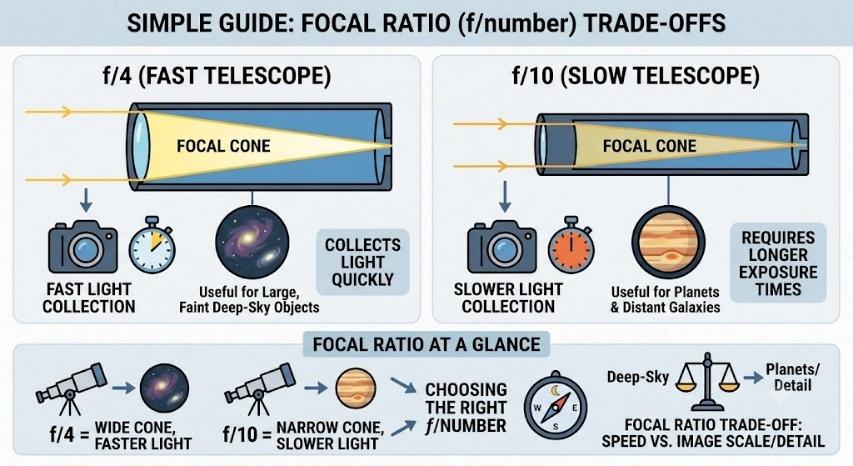
However, a faster telescope is not always better. Lower focal ratios can be more demanding in terms of focusing, optical design, and image correction. Slower systems may offer advantages such as easier handling and better suitability for certain subjects.
Focal ratio should always be considered together with aperture, focal length, camera, sky conditions, and the target being observed.
A common beginner mistake is to think that a faster telescope automatically produces better images. In reality, it is a trade-off between speed, image scale, optical performance, and practicality.
Focal ratio determines how efficiently light is collected, but the best choice depends on what you want to observe.